Real Paradise
The Old AxolotlReal Paradise is an inhabited African landscape where artificial waterways, abundant fields, and fantastical creatures sustain a carefully shaped world under Lady Spiro’s Mothernet. In the 100K PostApoc sequence, its defining contradiction is clear: paradise offers beauty and shelter, yet the Breath of Stone has made wanting itself recede. For Bartek, the place is at once home, a source of guilt, and a boundary he is preparing to cross.
Landscape and Setting
The landscape extends from a village across the Fields of Plenty toward the former town of Marsabit. Bartek passes over a bridge suspended above an artificial tributary of Lake Paradise, descends among sphinxes and brontosauruses, and later crosses a causeway beside the river. The scene mixes engineered features with an improbable bestiary: elsewhere, he scratches sphinxes and gummy bears behind their ears before mechanically splashing water from an artificial overflow onto Castlings playing in the sunshine. The setting is not simply wild nature or a town; its waterways, creatures, and settlements form a lived-in, partly artificial environment.
That abundance is overshadowed by the Breath of Stone. It hangs over the pink savanna from early morning and grips the whole Mother, reaching from the northern city ruins to Fergusson’s Karare backwater in the southwest. People have ceased wanting, even wanting to want, and slow into a hippopotamus-like indolence. Bartek leaves the village but finds himself longing to lie down again in the pen beside his fore-sons and fore-daughters and the empty, cold shells they left behind. The landscape’s ease is therefore inseparable from a loss of initiative: its inhabitants are surrounded by life, but stillness has settled over them.
A Managed Paradise
Lady Spiro’s presence makes the landscape feel governed as well as inhabited. From the clouds, she appears in the form of a creamy cumulus face, while a chorus of Earth, Water, and Sky chants after Bartek as he walks away. Later, she strokes his obsidian-egg-like head with fingers of golden rays. The scene gives the environment an intimate, responsive quality: the natural world seems to voice the invitation to return, and Lady Spiro is figured as part of that encompassing presence.
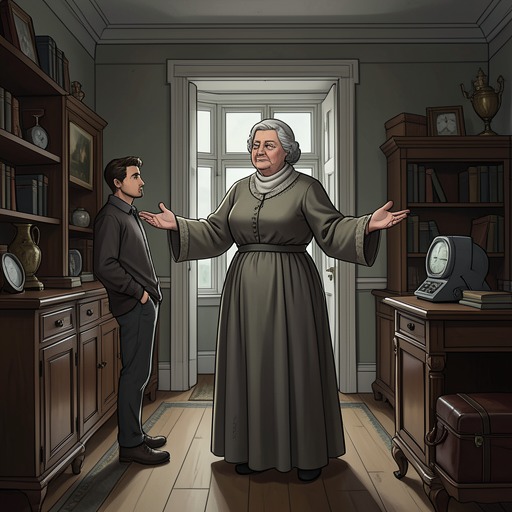
The rule behind this apparent welcome is made explicit when Bartek approaches the edge of the domain. Lady Spiro tells him she will not hold him back and describes her power as the sincere promise of happiness, insisting that there are no slaves in Paradise. The claim sits in tension with the Breath of Stone’s effects: a world without overt coercion can still be one in which desire and motion have ebbed. Real Paradise’s order is presented not through guards or force in these scenes, but through its Mothernet, its promise of happiness, and the emotional pull that makes leaving difficult.
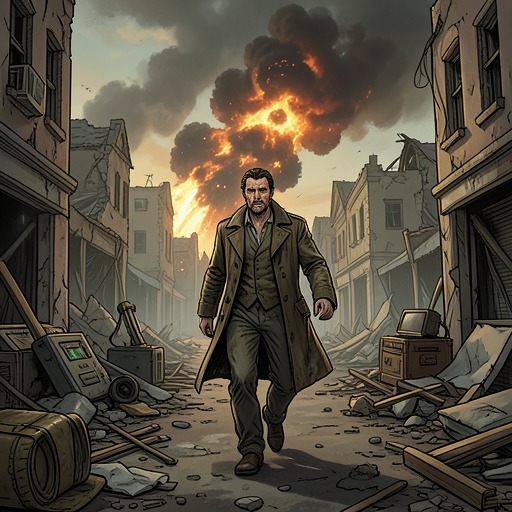
The visible boundary is Vultures’ Cliff, which marks the limit of Spiro’s Mothernet and of the rosy life of Paradise on Earth. From the firelight, Bartek sees that the ancient tower of the Marsabit National Park still stands above the cliff. The distance between him and the boundary is no more than twenty meters, a small physical gap that carries the weight of departure. In the night, Lady Spiro’s wooden mech follows him: hand-sculpted by her children from paradisal ebony, it has pole-like arms, plank-like legs, fingers plaited like coral, and a totemic mask. Its dry rattle is audible in the silence. Paradise’s maternal welcome thus has a material presence, but it does not erase the threshold Bartek is approaching.
The Castlings and the Work of Creation
The Castlings reveal a cost built into Paradise’s delicate forms. Their small bodies are pale and elfinly slender, but Bartek recognizes that they are infertile: their bodies have no room for reproductive systems. Too fragile and ethereal, they multiply through transformations and intermediary IS forms. Their existence makes the created world seem less like a stable, self-sustaining paradise than a continuing process of change, one whose future depends on forms that cannot reproduce in the ordinary way.
When Castlings on the lakeshore make a lumpy, four-armed human figure from mud and grass, the Mother vectors it toward Bartek, guiding it over stones and branches. It crawls up his body, weaves a nest of reeds across his chest, and performs fortune-telling rituals. Bartek watches with the patience of Atlas looking up at nearby celestial dances. The scene turns the landscape into an active participant: the figure is made from local materials, animated by the Mother, and brought into direct contact with him. The Castlings’ play also reaches into his private history. He remembers that his children and non-children, family and non-family, shadows and apparitions, and other humanoid oddities all burned up and were forgotten; only the hardware remained. In this setting, a small figure of mud and grass can call up an immense catalogue of loss.
Paradise’s apparent fertility is also qualified by what the Castlings gather and consume. In the southern Fields of Plenty, humanoids collect fruits used for exquisite alcohols and serotonin drugs. The same landscape that supplies abundance therefore also supplies substances associated with altered feeling. Bartek pretends to eat when the humanoids bind him with a banqueting vector, a moment of participation that remains a performance rather than an ordinary meal.
Bartek’s Belonging and the Edge of Departure
Bartek’s response to Paradise shifts between longing, frustration, and grief. As he leaves the village, the chorus behind him predicts his return, and Lady Spiro watches from the clouds. He answers by climbing into his iguarte, an Al-Asr handmade by the Arab Dwarves of the nomadic Trash Metal swarms, and emoting his anger at the Mother Hardware. Its metamatter face-mask can form familiar expressions, including a sigh swollen into something like a scream. The contrast between the mechanical mask and the pastoral setting makes his distress visible without making it simple: even in anger, the world’s pull remains strong.
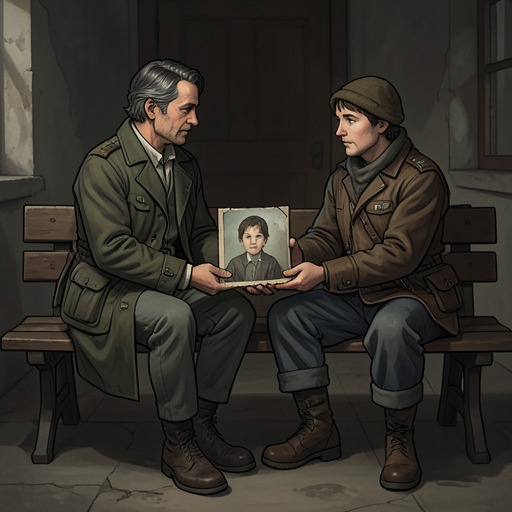
His later approach to Vultures’ Cliff gives that ambivalence a precise geography. Bartek switches to infrared to recognize the boundary, then leaves the circle of the firelight while Lady Spiro grants him permission to go. In another passage, he leads a visitor beyond the Mother of Real Paradise to the old park-ranger tower, with curious humanoids accompanying them. Those travelers pass the southern Fields of Plenty as the humanoids gather their fruits. The movement beyond the Mothernet’s reach does not erase the landscape behind them; Paradise remains present as both a place one can leave and a world that continues to shape what happens at its edge.
Narrative Significance
Real Paradise brings together engineered abundance, ecological fantasy, and the burden of attachment. Artificial tributaries and overflow coexist with sphinxes, gummy bears, Castlings, and a surviving park tower. None is merely scenery: water is directed onto playing bodies, the Mother animates a figure of earth and grass, and the boundary of the Mothernet determines where the life of Paradise ends. The landscape acts upon its inhabitants even as they move through it.
For Bartek, the decisive tension is that paradise can be both refuge and enclosure without being described as a conventional prison. Lady Spiro offers happiness rather than force, the chorus insists on his return, and his own memories make the place inseparable from the descendants he has lost. Yet he walks toward the cliff and beyond the Mother’s domain. Real Paradise matters because that departure is not a clean rejection: the world’s beauty, its stagnation, and its unresolved history travel with him.